Asoj 2083 BSअसोज २०८३· Nepal runs on its own calendar

Kathmandu Valley · old town

Bhaktapur

भक्तपुर Khwopa (Nepal Bhasa)

Bhaktapur, Khwopa in Nepal Bhasa, is the best preserved of the valley's three royal cities, 13 km east of Kathmandu. It has three great squares, the five-tiered Nyatapola, open-air potters and a famous sweet curd. Stay at least one night to see it at dawn and after the day visitors leave.

  • Stay 1–2 nights
  • Best Mar – Apr · Oct – Nov
  • पहाडPahad
Bhaktapur
Photo: Saroj Pandey · CC BY-SA 3.0, Wikimedia Commons

The air at Bhaktapur

Altitude1,401 m15.8% of the way to 8,849 m
BeltPahadपहाड · The middle hills: terraces, towns, rhododendron
Each breath84%of the oxygen at sea level
Water boils95.3 °Cso dal takes longer here
vs Kathmandu-0.0 °Ctypical difference by height

Oxygen, boiling point and temperature are worked out from the standard atmosphere for 1,401 m; real days vary with weather.

Bhaktapur feels like a working town that happens to be full of temples. Cars are restricted in much of the old core, so the sounds are of hand looms, dhime drums practising for a festival, potters' wheels and grain being threshed on the paving. Farmers still walk out each morning to fields at the town's edge, and many families have lived in the same tole for generations.

The town has three main squares. The Durbar Square holds the 55-Window Palace and the Golden Gate. Taumadhi has Nyatapola, at about 30 m the tallest temple in Nepal, and the Bhairav temple beside it. Tachupal, the oldest quarter, has the Dattatreya temple and the carved Peacock Window. Between them run lanes of brick houses with carved windows, sunken water spouts and small ponds.

Bhaktapur suffered badly in the 2015 earthquake, losing houses and several temples. Much has been rebuilt by local craftsmen, partly paid for by the visitor fee the municipality charges at its gates. The fee is higher than elsewhere in the valley, and it shows: streets are cleaner, restoration more careful and the old town more intact than anywhere else in Nepal.

Why go

Taumadhi and Nyatapola

Climb the steep stairs of the five-roofed Nyatapola past its stone guardians, then sit on the steps and watch the square. The Bhairav temple stands beside it. Cafes on the square's upper floors look across both temples.

Durbar Square and the Golden Gate

The 55-Window Palace, the gilded Golden Gate of 1754 leading to the Taleju courtyard, and a row of rebuilt stone and brick temples. Mornings are quietest; school groups arrive by late morning.

Pottery Square

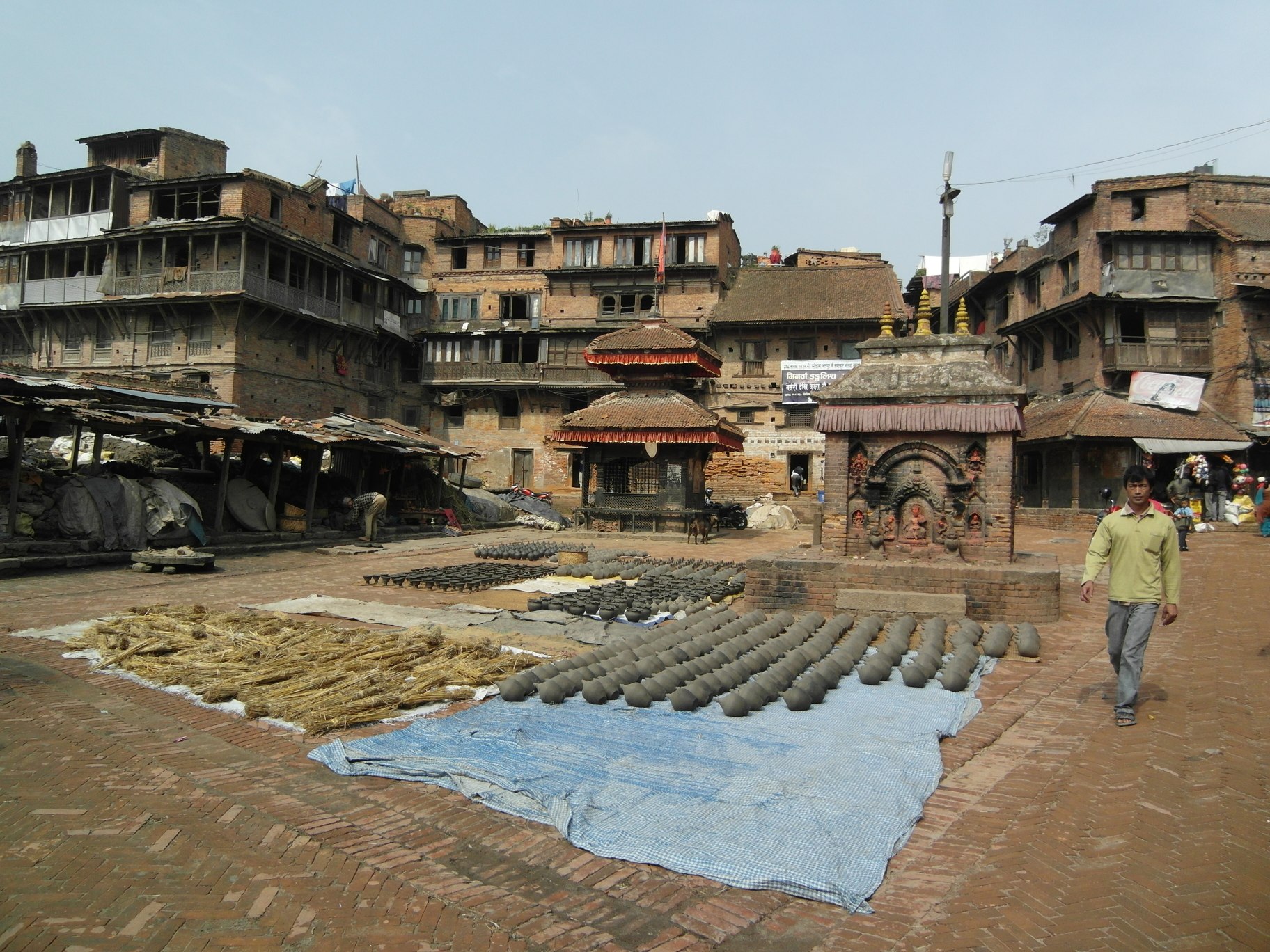
In Talako, potters throw bowls, pots and piggy banks on hand-spun wheels, and set hundreds out to dry in the sun on the paving. Watch, try a wheel, and buy a small pot from the maker.

Tachupal and the Peacock Window

The oldest quarter of town, centred on the Dattatreya temple. In a lane nearby, the Pujari Math has a carved wooden window with a fanned peacock, one of the most famous in Nepal. A woodcarving museum is next door.

Siddha Pokhari at the gate

A large rectangular pond at the western entrance to the old town, from the Malla period, with fish, egrets and elderly men on benches. A good place to start a walk or end the day.

Bisket Jatra in April

Bhaktapur's New Year festival, when the chariots of Bhairav and Bhadrakali are hauled through the streets by competing halves of the town and a tall pole is raised and pulled down. Loud, crowded and exciting.

१The story of Bhaktapur

The old capital that kept its own ways

Tradition credits King Ananda Deva Malla with founding or expanding Bhaktapur in the 12th century, and for about three centuries it was the capital of the whole valley. After King Yaksha Malla died in 1482, his heirs divided the kingdom and Bhaktapur became one of three rival cities. Its kings were great builders: Bhupatindra Malla raised Nyatapola in 1702 and much of the palace; Jaya Ranjit Malla added the Golden Gate in 1754.

Bhaktapur was the last of the three cities to fall to Prithvi Narayan Shah, in 1769. It then sank into a quiet farming town while Kathmandu grew. That neglect saved it. When the German-funded Bhaktapur Development Project began in 1974, it restored temples and installed drains and paving, but the town's layout and life were largely unchanged. Today Bhaktapur still speaks Nepal Bhasa first.

The 1934 earthquake had already destroyed much of the old palace, and the 2015 quake brought down the Vatsala Durga temple, Fasidega and many houses. Nyatapola, built on a stepped stone base, survived both. Rebuilding has been led by the municipality and local craftsmen, using the visitor fees. Walk the lanes now and you will see brand new carved windows next to old ones, set in walls of salvaged brick.

२The legend
As it is told · भक्तपुर

Local legend says Bhairav, the fierce form of Shiva in his temple at Taumadhi, grew restless and troubled the town. King Bhupatindra Malla was told to build a temple for a goddess stronger than Bhairav, so he raised Nyatapola for Siddhi Lakshmi beside Bhairav's shrine. People say the king carried the first bricks himself, and that the stone guardians on its stairs grow ten times stronger with each step, ending with the goddesses at the top.

३The people

Who lives here

Bhaktapur is a Newar town, and Nepal Bhasa is its daily language. Jyapu farming families work the fields at the edge of the town, Prajapati families make pots in their courtyards, and woodcarvers, metalworkers and painters keep their trades alive. The town's festival life depends on guthis and on families such as the Banmala, who dance the Navadurga masked dances. Many younger people now work in Kathmandu but return for every jatra.

Local name: Khwopa (Nepal Bhasa)

४Words you will hear
Nepal Bhasa
ख्वप
Khwopa

Bhaktapur, the Newar name for the town

Nepal Bhasa
धिमे
Dhime

Large two-sided Newar drum played in festival processions

Nepali
पाटी
Pati

Open public rest house, often run by a guthi

Every word on this site

५What to eat

Juju dhau

The king of curds: buffalo milk boiled down, sweetened and set in unglazed clay bowls, so it turns thick, creamy and slightly caramel. Buy it fresh from small shops round the Durbar Square and Taumadhi, eaten with a spoon from the bowl. Mornings are best, before the day's batch sells out.

६Few people know

Things most guides leave out

The stone guardians on Nyatapola's five stair platforms are arranged so each pair is said to be ten times stronger than the pair below: two legendary wrestlers, then elephants, lions, griffins and finally the goddesses Baghini and Singhini.

Wikipedia: Nyatapola

Bhaktapur was the capital of the whole Kathmandu Valley until the late 15th century. Only after King Yaksha Malla's death in 1482 did the kingdom split into the separate city-states of Bhaktapur, Kathmandu and Patan.

Wikipedia: Bhaktapur

From 1974 to the mid-1980s, the German-funded Bhaktapur Development Project paved streets, built drains and restored temples, one of the first large urban conservation projects in Nepal. Its work is a reason the old town is so intact.

Wikipedia: Bhaktapur

Untold Nepal, region by region

Getting there

How to reach Bhaktapur

Road

Bhaktapur is 13 km east of central Kathmandu. A taxi or private car takes 45 minutes to an hour, longer in rush hour, via the Araniko Highway or Kausaltar. Local buses leave from Ratnapark and Bagbazar in Kathmandu for the Bhaktapur bus park near Siddha Pokhari, taking about an hour. The old core is mostly closed to cars.

On foot

A popular walk links Changunarayan and Bhaktapur: about 2 hours downhill through fields and villages from the temple to the old town. From Nagarkot, the walk via Telkot and Changunarayan takes most of a day.

Where to stay

Stay inside the old town if you can. Small guesthouses and boutique hotels in restored Newar houses cluster round Taumadhi, the Durbar Square and Tachupal, and many have rooftop terraces looking over the temples. Rooms are simple to mid-range; book early for Bisket Jatra in April. Larger hotels sit along the main road outside the core. Many travellers combine a Bhaktapur night with Nagarkot, 45 minutes up the hill.

Local tips

  • Keep your Bhaktapur ticket; with your passport, it can be extended for longer stays at the ticket office.
  • Arrive by 7 am or stay overnight to see locals at puja, and the squares before groups arrive.
  • Buy juju dhau in the morning, when it is fresh and the shops have full stock.
  • Ask potters before photographing them close up, and buy a small piece if you spend time at a wheel.
  • Wear shoes with grip; brick paving is slippery after rain and steep on Nyatapola's stairs.

On the map

Bhaktapur and what is near it

Map of Bhaktapur, Changunarayan, Nagarkot, Kathmandu, PanautiIndiaChinaNepalGandakiBhaktapur1BhaktapurChangunarayan2ChangunarayanNagarkot3NagarkotKathmandu4KathmanduPanauti5Panauti50 kmN
  1. 1Bhaktapur
  2. 2Changunarayan
  3. 3Nagarkot
  4. 4Kathmandu
  5. 5Panauti
Drawn by Book Nepal Trip from Natural Earth outlines (public domain). International borders as depicted by Nepal. Rivers: Karnali, Gandaki and Koshi systems. Not for navigation.

Questions

Bhaktapur: what travellers ask

How far is Bhaktapur from Kathmandu?

About 13 km east of central Kathmandu. By taxi or private car it takes 45 minutes to an hour, more in rush hour. Local buses from Ratnapark and Bagbazar take about an hour and stop near Siddha Pokhari, at the edge of the old town. It also makes a good stop on the way to Nagarkot.

How much time do I need in Bhaktapur?

Half a day covers the three squares and Pottery Square. A full day lets you eat, wander the lanes and visit the woodcarving museum. We recommend one night, so you see the town at dawn and dusk. Two nights works well with a day trip to Changunarayan or Panauti.

What is Bhaktapur famous for?

Bhaktapur is known for its well-preserved old town, three squares of Malla-era temples, the five-roofed Nyatapola, Pottery Square, the Peacock Window, juju dhau curd, and festivals like Bisket Jatra and Gai Jatra. It is part of the Kathmandu Valley UNESCO World Heritage Site.

Was Bhaktapur damaged in the 2015 earthquake?

Yes. Several temples, including the Vatsala Durga temple in the Durbar Square, and many houses collapsed or were damaged. Nyatapola survived. Most monuments have been rebuilt, partly with entry-fee income, and the town is fully open, though you will see some construction.

Why is the Bhaktapur entry fee higher than other sites?

The Bhaktapur municipality sets its own fee and uses it for heritage conservation, cleaning and services in the old town. The fee covers the whole town for your visit and can be extended for longer stays. Fees change, so check current status before you travel.

When is the best time to visit Bhaktapur?

October and November are clear and pleasant. March and April are warm, and mid-April brings Bisket Jatra, the town's biggest festival. Gai Jatra, in August or September, is longer and more theatrical here than in Kathmandu. Monsoon is wet but the town is quiet.

Is Bhaktapur safe to walk alone?

Yes. The old town is lived in, compact and generally very safe by day and evening. Take normal care with valuables in crowds during festivals. Lanes are poorly lit at night and paving is uneven, so use a phone torch and watch for steps and drains.

Can I combine Bhaktapur and Nagarkot?

Yes, they pair well. Spend a day and night in Bhaktapur, then drive 45 minutes up to Nagarkot for sunset and sunrise. Or walk from Nagarkot down via Telkot and Changunarayan to Bhaktapur in most of a day, an easy descent through villages and forest.

What should I buy in Bhaktapur?

Clay pots and lamps from Pottery Square, woodcarvings and miniature windows from the workshops round Tachupal, handmade paper, and Bhaktapur-woven cloth. Juju dhau is the edible souvenir. Buy from makers where you can, and ask for a receipt for larger pieces.

Plan with a local planner

Tell us your height, we will find the trail

Easy hills or a 5,000 m pass, a week or a month: three short questions and a planner sends a first plan, with the sleeping height of every night and an itemised price.

  1. १Tell us where, when and how high you want to go
  2. २Get a first plan and an itemised price within one working day
  3. ३Change anything until it fits. Pay a deposit only when you book
Plan my Nepal trip