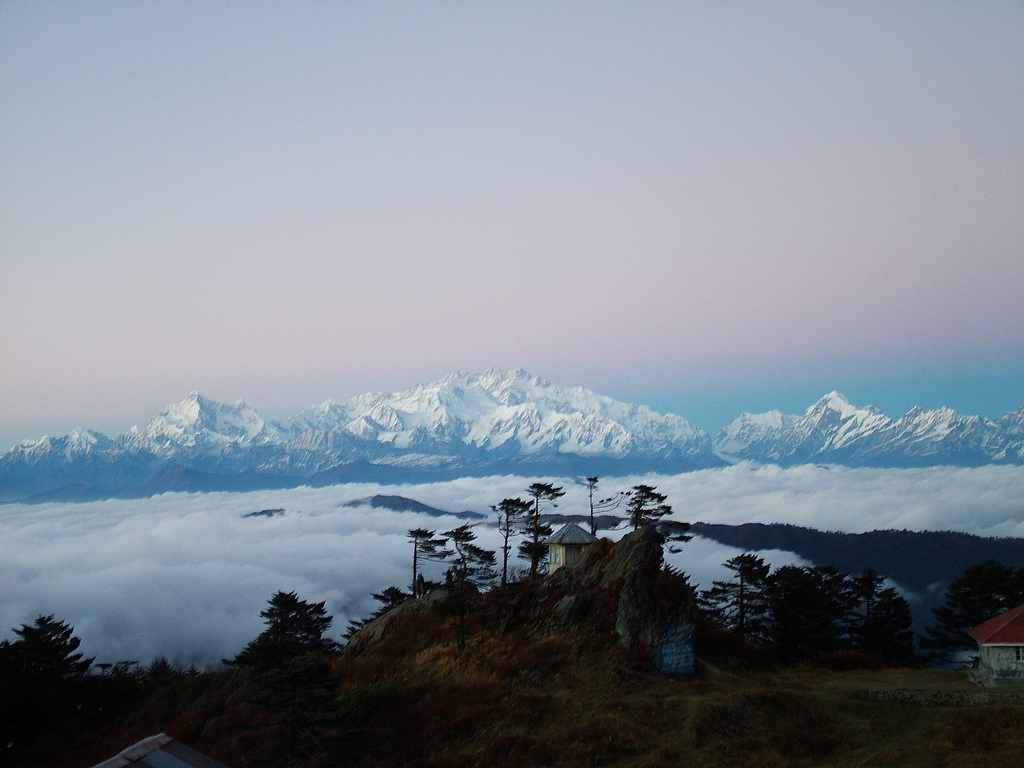
Why Kanchenjunga is different
Kanchenjunga, at 8,586 m, is the third-highest mountain on earth and the most easterly of Nepal's giants. Its five summits stand on the border with Sikkim, and on the Nepal side the whole upper valley system of the Tamor river is protected as the Kanchenjunga Conservation Area. The area was declared in 1997, covers about 2,035 square kilometres of Taplejung district, and is one of the few protected areas in Nepal managed by a council of local people rather than by the army or a government warden.
That local control, and the restricted area rules that come with the border, shape the trek. There are no crowds, no chain lodges and no souvenir alleys. Most groups walk for days without meeting another foreign trekker. In return, everything takes more planning: permits must be issued in Kathmandu before you start, the drive to the trailhead takes two days, and a licensed guide is not optional but a legal requirement.
We have written this guide for people deciding between routes and trying to understand the permit system. Rules and fees change, sometimes with little notice, so read every number below as the situation as we understand it and check current status before you travel.
The permits you need
Two permits cover the standard Kanchenjunga routes. The first is the restricted area permit, issued by the Department of Immigration in Kathmandu. It is only issued through a registered Nepali trekking agency, only to groups of at least two foreign trekkers, and only when a licensed guide walks with the group. The fee has been charged per person per week, about USD 20 a week for the first four weeks, with a higher weekly rate after that. Your agency needs your passport, a visa valid for the trek dates, photos and the full itinerary.
The second is the Kanchenjunga Conservation Area entry permit, which has been about NPR 3,000 for foreign visitors. It can be bought in Kathmandu or, at times, at the entry checkpoint, but we always arrange it in advance. Both permits are checked and recorded at several posts along the trail, including Sekathum and Ghunsa, so keep them dry and handy.
Since April 2023 Nepal has required foreign trekkers in national parks and conservation areas to walk with a licensed guide. In Kanchenjunga this changes little in practice, because the restricted area permit already demanded a guide, but it does mean the rule applies even to sections outside the restricted zone. Check current status before you travel.
- Restricted area permit: Department of Immigration, via a registered agency, minimum two trekkers, licensed guide required
- Kanchenjunga Conservation Area entry permit: about NPR 3,000 per foreign visitor
- Original passport with a Nepal visa covering every day of the trek
- Travel insurance that covers trekking to at least 5,200 m and helicopter evacuation
North, south or the full circuit
The north route follows the Tamor and Ghunsa valleys to Ghunsa, Kambachen and Lhonak, ending at Pang Pema, the north base camp at 5,140 m. It is the classic line, with the biggest views of the north face and of Jannu, and it now has simple lodges at every stop. From Kathmandu it takes about 20 nights with two acclimatisation days and spare time for flights.
The south route goes from the road head near Yamphudin up the Simbua Khola to Tseram and Ramche, with a dawn walk to the Oktang viewpoint above the Yalung glacier. It is shorter and lower, with a highest night of about 4,580 m at Ramche, and passes through some of the finest rhododendron forest in Nepal. Lodges are simpler and fewer.
The circuit links the two by crossing from Ghunsa over Sele Le and a chain of passes, the highest about 4,700 m, to Tseram. It takes about 24 nights from Kathmandu and is the most rewarding way to see the mountain, but the pass day is long and must not be attempted in fresh snow.
| Route | Nights from Kathmandu | Highest night | Grade | Best for |
|---|---|---|---|---|
| North base camp (Pang Pema) | ≈ 20 | 5,140 m | Strenuous | The north face, Jannu, high valley villages |
| South base camp (Oktang) | ≈ 14–16 | 4,580 m (Ramche) | Challenging | Rhododendron forest, the Yalung glacier |
| Full circuit | ≈ 24 | 5,140 m | Strenuous | Both faces, no retracing, the Sele Le crossing |
A planner can turn what you are reading into days, nights and a price.
Stages and altitudes on the north side
From Taplejung bazaar, also called Phungling, a jeep road now runs up the Tamor valley, and most groups drive as far as Sekathum at about 1,660 m. Where the road ends changes after each monsoon. From Sekathum the walk goes through a gorge to Amjilosa at about 2,510 m, then through forest to Gyabla at about 2,730 m and up past Phole to Ghunsa at 3,595 m, where we take a rest day.
Above Ghunsa the trees end. Kambachen at about 4,050 m is a summer settlement under Jannu, and it is where we take the second rest day. Lhonak at about 4,780 m is a sandy plain beside the glacier, and Pang Pema at 5,140 m has a basic teahouse. Most people sleep there, climb the ridge above at dawn, and return to Kambachen the same day.
The two acclimatisation days are not padding. The jump from Ghunsa to Pang Pema is more than 1,500 m in three walking days, and altitude sickness here is a real risk. Our guides carry a pulse oximeter, and the rule is simple: if symptoms do not clear with rest, we go down.
Lodges, food and money
Lodges on the Kanchenjunga trails are family-run and simple. Expect twin rooms with thin walls, shared toilets, one heated dining room and a menu of dal bhat, noodles, potatoes, Tibetan bread and tea. Hot showers, charging and wifi, where they exist, cost extra. Above Ghunsa there are only a handful of lodges, and in the quietest weeks some close, so your guide will phone ahead.
There is no ATM after Taplejung. Carry enough Nepali rupees for drinks, showers, charging and small purchases, about NPR 2,000 to 3,000 a day. Mobile signal is patchy above Sekathum; we carry a satellite messenger. Porters and guides are usually from the Tamor valley, and many are Limbu, Rai or Sherpa. Tips are customary at the end of the trek.
Fitness, kit and safety
You do not need climbing skills for any Kanchenjunga route, but you do need stamina for 12 or more walking days of five to eight hours on steep, rough ground. Before you come, walk long hilly days back to back with a loaded pack. Bring broken-in boots, poles, a down jacket, a four-season sleeping bag rated to about −15 °C, gaiters for snow on the passes, and a water filter or purification tablets.
Helicopter rescue is possible from most of the route but depends on weather and can take a day to arrange, so your insurance must cover evacuation from above 5,000 m. Talk to your doctor about acetazolamide for altitude before you travel.
Costs and how to plan
A guided north base camp trek with flights, jeeps, both permits, a guide, porters, lodges and meals typically costs from about USD 2,850 per person for 20 nights; the circuit from about USD 3,350 for 24 nights. The main costs are the domestic flight to Bhadrapur, two days of private jeep each way, the weekly restricted area fee and porters, because all supplies above the road are carried in.
Book at least six weeks ahead so the agency can apply for the restricted area permit in good time. Choose October or November for clear skies, or April for flowers. Build in at least one spare day in Kathmandu after the trek, because flights in the east are often delayed by weather and roads can close after rain.
Questions
How much is the Kanchenjunga restricted area permit?
The restricted area permit has been charged per person per week, at about USD 20 a week for the first four weeks and a higher weekly rate after that. It is issued by the Department of Immigration in Kathmandu only through a registered agency, for at least two trekkers with a licensed guide. Fees change, so check current status before you travel.
Can I trek Kanchenjunga without a guide?
No. Kanchenjunga is a restricted area, so the permit is only issued to groups booked through a registered agency and walking with a licensed guide. Since April 2023 Nepal has also required foreign trekkers in conservation areas to use a licensed guide. Independent trekking here is not allowed. Check current status before you travel.
Can a solo traveller get a Kanchenjunga permit?
Not alone. The permit needs a minimum of two foreign trekkers. Solo travellers can join another trekker on the same dates through an agency, or book a private trip priced for two. Some agencies match solo trekkers. Tell us your dates early so we can try to find a partner for you.
How many days do I need for the Kanchenjunga trek?
Allow about 20 nights from Kathmandu for the north base camp route, about 14–16 for the south side to Oktang, and about 24 for the full circuit. These include two days of driving each way and acclimatisation days. Add one or two spare days in Kathmandu for weather delays.
What is the highest point on the Kanchenjunga trek?
On the north route, the highest sleeping point is Pang Pema at 5,140 m, and the ridge above it at dawn goes a little higher. On the circuit, the passes between Sele Le and Tseram reach about 4,700 m. On the south route, Ramche at about 4,580 m is the highest night and Oktang is a viewpoint just above it.
Where are the Kanchenjunga permits checked?
Permits are checked and recorded at several posts, including near Sekathum at the start of the trek and at Ghunsa, and on the south side near Yamphudin. Your guide keeps the restricted area permit with the group papers, and you should carry your passport and conservation area permit in a dry pouch.
Is there a TIMS card for Kanchenjunga?
For restricted areas such as Kanchenjunga, the restricted area permit is the key document, and agencies handle any extra registration that applies. TIMS rules have changed several times since 2023. Your agency will tell you exactly which documents are needed for your dates. Check current status before you travel.
When is the Kanchenjunga trek closed?
The trails are not formally closed, but from December to February snow and cold close many lodges above Ghunsa and make the Sele Le crossing unsafe. In the monsoon, from June to August, landslides, leeches and cloud make trekking hard and views rare. Most groups go in October, November, April and early May.
How do I reach the Kanchenjunga trailhead?
Fly from Kathmandu to Bhadrapur, about 50 minutes, then drive through Ilam to Taplejung over one or two days. From Taplejung a jeep road runs up the Tamor valley toward Sekathum. For the south side, jeeps go toward Yamphudin. Flights to Suketar above Taplejung are irregular, so we do not rely on them.