
Where Nepal's tea began
Ilam is a hill district in the far east of Nepal, on the border with Darjeeling. Its bazaar sits on a ridge at about 1,200 m, and the slopes around it are covered in tea bushes clipped to waist height and cut by narrow paths. The first tea estate in Nepal was planted here in 1863, and the old Ilam estate below the bazaar is still worked today. Ilam bazaar itself is older: it was set up in 1818 as an administrative post of the Gorkhali state.
Tea in Ilam is orthodox tea, made the slow way: leaf is withered on racks, rolled, oxidised and dried, as in Darjeeling across the ridge. Down on the plains of Jhapa you will see flat CTC gardens, which make the strong granular tea most Nepalis drink with milk and sugar. Up here the focus is on whole leaf, much of it sold abroad, some of it under its own name, and much of it grown by small farmers who sell fresh leaf to the factories.
For more than a century tea here meant a few large estates. In the late twentieth century that changed, as the government encouraged tea across the eastern hill districts and farming families began to plant bushes on their own terraces beside maize and cardamom. Today the picture you see from the road is a patchwork: the old estates with their shade trees and factories, and hundreds of small family plots whose leaf is carried in sacks to the nearest collection point each morning. When you buy tea in Ilam, you are very often buying the work of those smallholders.
Ilam is also more than tea. It is famous across Nepal for round Akabare chillies, chhurpi cheese, cardamom, broom grass and milk, and for the forest lake of Mai Pokhari and the Singalila ridge at Sandakpur.
The four flushes
Tea bushes in Ilam rest through the cold, dry winter and push out new shoots as the days warm. Each burst of new growth is a flush, and each tastes different. Knowing them helps you choose when to visit and what to buy.
Pickers take two leaves and a bud from each shoot, by hand, every week or so in the growing season. The best leaf is picked early in the morning. On a factory visit you will see it spread on long withering troughs, rolled in machines that look like large iron tables, laid out to oxidise and then dried in hot-air dryers.
When you taste, do it the way the makers do: a small measure of leaf, water just off the boil, three to four minutes, and a look at the wet leaf as well as the cup. Smell the leaf first, then sip loudly to spread the tea across the tongue. A good first flush smells of flowers and fresh grass; a good autumn tea smells of fruit and honey.
| Flush | When | Taste | Good to know |
|---|---|---|---|
| First flush | Late March – April | Light, floral, green | The most prized and most expensive leaf |
| Second flush | May – June | Fuller, fruity, amber | Many people's favourite all-rounder |
| Monsoon flush | July – September | Strong, plain | Mostly used in blends |
| Autumn flush | October – November | Round, mellow, sweet | Clear skies and the best mountain views |
Places to see in and around Ilam
Most of what you will want to see lies within two hours of the bazaar. We plan days so the long drives come early, when skies are clearest, and the tea walks come late, when the light is soft.
- Ilam tea estate: the oldest garden in Nepal, a walk from the bazaar, best in early morning or late afternoon
- A small orthodox factory: see withering, rolling, oxidising and drying from late March to November
- Kanyam: a broad slope of clipped tea at about 1,570 m on the Mechi Highway, about 35 km from Ilam, busy with Nepali families on Saturdays
- Fikkal: the market town for the southern tea villages and a base for early drives to Antu Danda for sunrise
- Mai Pokhari: a sacred lake at about 2,100 m north of Ilam, ringed by forest and listed as a Ramsar wetland in 2008
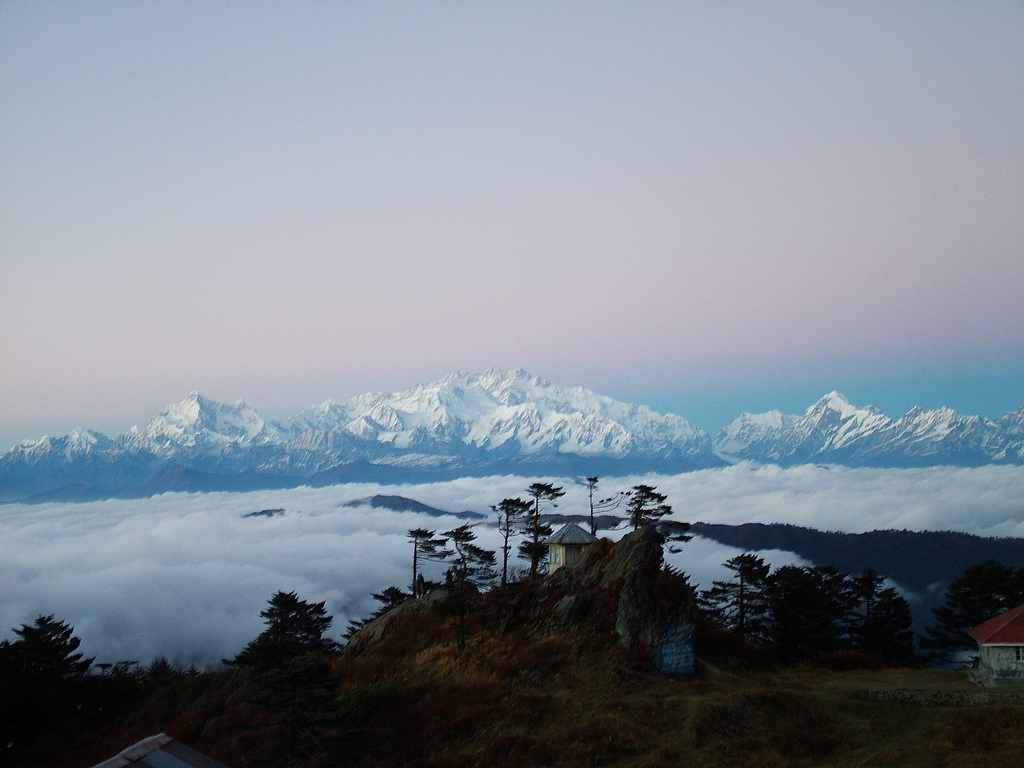
- Sandakpur: the Nepal side of the Singalila ridge at 3,636 m, with Everest, Lhotse, Makalu and Kanchenjunga at sunrise
- Ilam bazaar: wooden balconies, tea shops and stalls selling chhurpi, round chillies and loose-leaf tea
A planner can turn what you are reading into days, nights and a price.
How many days to spend
Two nights is the minimum to enjoy Ilam: one to arrive and walk the estate, and one for a factory visit and either Kanyam or Mai Pokhari. Four nights lets you do all of these slowly, with a night at Kanyam among the tea and time for a village kitchen. Five or six nights lets you add Sandakpur, which needs a full day up and a full day down on rough roads, ideally with a night at Mai Pokhari on the way to adjust to the height.
Ilam also links well with other trips in the east. It is the natural first and last night on the road to Taplejung for the Kanchenjunga trek and the Pathibhara Devi pilgrimage, and it pairs well with two nights of birding at Koshi Tappu on the plains. Our Ilam journeys run from four to six nights, and we add Ilam nights to most of our eastern treks.
Getting there and getting around
The easiest way in is a flight from Kathmandu to Bhadrapur in Jhapa, about 50 minutes, followed by about 100 km and 3–4 hours by car through Birtamod or Charali and up the Mechi Highway. The Mechi Highway climbs about 74 km from the East–West Highway to Ilam bazaar, passing Kanyam and Fikkal on the way.
Overnight buses run from Kathmandu to Ilam in about 14–16 hours, and from India the border crossing at Kakarbhitta is about 2–3 hours from Ilam by car. Around Ilam, a private car with driver is by far the easiest way to move between tea gardens, viewpoints and villages, and for Sandakpur you need a 4WD jeep. Local buses and shared jeeps run on the main roads but are slow and crowded.
Where to stay and what to eat
Ilam has no international chain hotels. In the bazaar there are simple, clean hotels and guesthouses, and in the villages around town and at Kanyam there are family homestays where you sleep in a farmhouse and eat what the family eats. Rooms usually have hot water by geyser or bucket. Book ahead for Saturdays and Nepali holidays, when domestic visitors fill the best rooms.
Eat chhurpi, both the soft kind cooked in curries and the hard kind chewed for hours; kinema, fermented soybean; gundruk, fermented greens; and achar made with Akabare chillies. Drink your way through the flushes, and try a glass of tongba in the evening. Buy loose-leaf tea from the factories or small shops in the bazaar; it is fresher than the boxed tea at the airport.
Tips for your visit
- Come between late March and November to see tea being picked and made; in winter the bushes rest.
- Visit the estate at dawn or late afternoon for the best light and cooler air.
- Ask before photographing pickers, and never walk through rows where they are working without asking.
- Carry a cloth bag: Ilam bazaar banned plastic bags from its market in 2010.
- Bring a warm layer: evenings in Ilam can be cool even in spring, and Sandakpur is often below freezing at night.
Questions
Is Ilam tea good?
Yes. Ilam grows orthodox tea on the same range of hills as Darjeeling, using the same methods, and its best first and second flush teas are very good, often lighter and more floral than Darjeeling and less expensive. Quality varies between gardens and factories, so taste before you buy. Many Ilam teas are sold abroad.
When was tea first planted in Ilam?
The first tea estate in Nepal was planted in Ilam in 1863, and the old Ilam estate below the bazaar is still in production. Tea spread slowly at first. Smallholder tea grew much more after the 1970s and 1980s, when farmers across Ilam, Panchthar and neighbouring districts planted tea on their own land.
Can I visit a tea factory in Ilam?
Yes. Several small orthodox factories in and around Ilam welcome visitors, especially when arranged in advance through a guide. The best time is late March to November, when picking is in full swing. Factories are working places, so visits are short and timed around production.
How far is Ilam from Kathmandu?
By road it is about 600 km and 14–16 hours by overnight bus. By air, you fly to Bhadrapur in about 50 minutes and drive 3–4 hours up the Mechi Highway. Most visitors take the flight. From the Indian border at Kakarbhitta, Ilam is about 2–3 hours by car.
How many days should I spend in Ilam?
Two nights is enough for the tea estate, a factory visit and either Kanyam or Mai Pokhari. Four nights lets you see them all slowly. Add one or two nights more for Sandakpur, which needs a long jeep day each way. Ilam is also a good first and last night on the road to Taplejung.
What is Kanyam?
Kanyam is a broad slope of clipped tea bushes at about 1,570 m on the Mechi Highway, about 35 km south of Ilam bazaar. It is part of Suryodaya municipality, near Fikkal. It is popular with Nepali families on weekends and is at its best in early morning and late afternoon light.
Can I see the mountains from Ilam?
On clear mornings, especially from October to January, the Kanchenjunga range is visible to the north from the ridges around Ilam. For the full panorama of Everest, Lhotse, Makalu and Kanchenjunga, go up to Sandakpur on the Singalila ridge at 3,636 m, a long day by jeep from Ilam.
What should I buy in Ilam?
Buy loose-leaf orthodox tea from the factories or bazaar shops, especially first or autumn flush. Hard chhurpi makes a long-lasting snack to take home. Akabare chillies, pickled or dried, are an Ilam speciality. Cardamom from the hills is also good value.
Is Ilam safe for travellers?
Yes. Ilam is a calm hill district with friendly people and little crime. The main risks are road ones: mountain roads, landslides in the monsoon and fog in winter. Use a private car with an experienced driver, travel in daylight and follow local advice after heavy rain.


.jpg)