Asoj 2083 BSअसोज २०८३· Nepal runs on its own calendar

Everest & Solukhumbu · trek stop

Lukla

लुक्ला

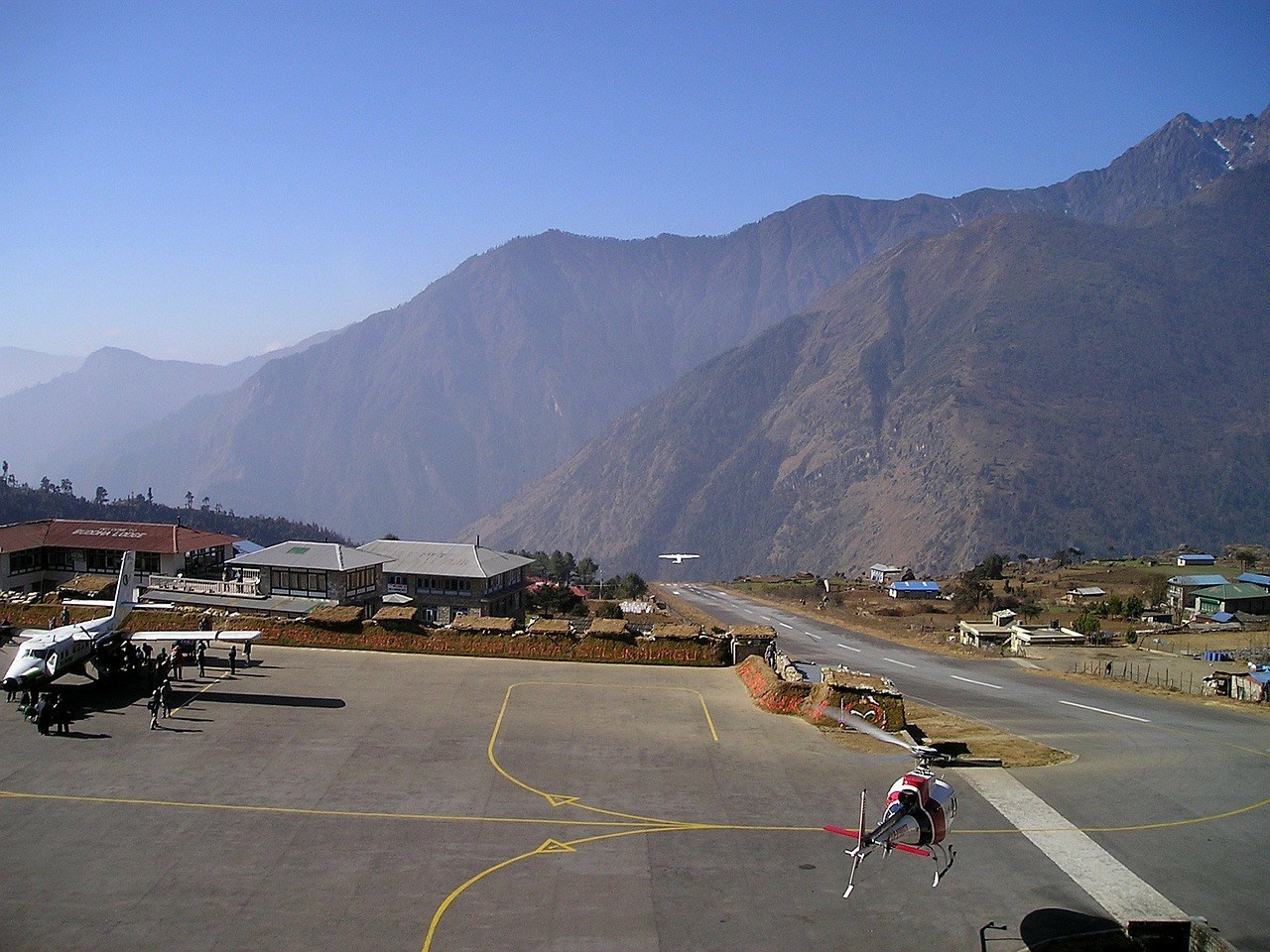
Lukla is the airstrip town at about 2,860 m where most Everest treks start and finish. Flights from Kathmandu, or from Ramechhap in peak seasons, land on a short, steep runway. Most people spend a night here at most, collect permits, meet porters and walk downhill to Phakding.

  • Stay 1 nights
  • Best Mar – Apr · Oct – Nov
  • लेकLekh
Lukla
Photo: Vyacheslav Argenberg · CC BY 4.0, Wikimedia Commons

The air at Lukla

Altitude2,860 m32.3% of the way to 8,849 m
BeltLekhलेक · High hills: pasture, pine, the last fields
Each breath70%of the oxygen at sea level
Water boils90.3 °Cso dal takes longer here
vs Kathmandu-9.5 °Ctypical difference by height

Oxygen, boiling point and temperature are worked out from the standard atmosphere for 2,860 m; real days vary with weather.

Lukla sits on a shelf above the Dudh Koshi gorge, a long street of lodges, gear shops, bakeries and porter agents running up from the airstrip. Before 1964 there was no town here worth the name, just Sherpa fields belonging to the villages of Chaurikharka and Chheplung. Then Edmund Hillary's team cleared a strip to fly in materials for the schools and clinics he was building in Khumbu, and Lukla turned into the front door of Everest.

Today the airstrip handles dozens of flights on a clear spring or autumn morning and none at all when cloud sits in the valley. That rhythm governs the town. Mornings are a rush of propellers, duffel bags and porters with doko baskets; afternoons are quiet, and when the weather closes, the lodges fill with people waiting for tomorrow. Most travellers pass through in an hour on the way in and spend their last night here on the way out.

We treat Lukla as a working stop rather than a destination. It is where you pay the municipality permit, meet your porter, eat a proper breakfast and adjust your pack before the first, mostly downhill, walk to Phakding. On the way back it is where you hand out tips, share a last meal with your crew and hope for a clear morning. Give it a spare day in your plan.

Why go

Morning flights over the wall

From the viewing spots along the airport fence you can watch aircraft land uphill on a runway of about 527 m and turn onto the apron in seconds. The first hour after dawn is busiest in October and April, when planes arrive in waves between gaps in the cloud.

The first walk to Phakding

The trail leaves the top of Lukla's main street and drops through Chheplung and pine forest to the Dudh Koshi, reaching Phakding at about 2,610 m in 3–4 hours. Losing height on the first night is good for acclimatisation and a gentle start for the legs.

Chaurikharka village fields

Below Lukla, Chaurikharka is an older Sherpa farming village of stone houses, potato and buckwheat fields and a village gompa. An hour's loop on its paths shows the farm life that existed long before the airstrip, and very few trekkers bother to look.

Gear check and porter meeting

Lukla is where you meet your porter and repack. Your porter usually carries one duffel per trekker, around 10–12 kg; you carry water, layers and snacks. Gear shops sell and rent jackets, poles and sleeping bags if anything was forgotten.

The last-night dinner

On the way out, Lukla is where trekkers share a final dinner with their guide and porters and hand over tips. Lodges cook dal bhat, momo and Sherpa stew, and it is a fine place to say thank you properly before the morning flight.

१The story of Lukla

A runway built for schools, not tourists

In the early 1960s Edmund Hillary was building schools and clinics in Khumbu through the Himalayan Trust, and every sheet of roofing and bag of cement had to be carried for days from the roadhead. An airstrip would change that. In 1964 he bought land at Lukla from local Sherpa farmers and his team, with local labour, cleared and levelled a strip on the slope. The first aircraft landed on grass and earth.

For years the strip served the Trust and a trickle of trekkers. As the trekking business grew from the 1970s, so did Lukla: lodges went up along the trail, the runway was paved in 2001, and in 2008 the airport was renamed Tenzing-Hillary Airport in honour of the two men who first stood on Everest's summit in 1953. The runway is short, about 527 m, and climbs at roughly 12 percent towards a stone wall, so pilots land uphill and take off downhill with no second chance.

Lukla's people are mostly Sherpa, with Rai, Tamang and other families who came for work. Many lodge owners started as porters or guides. Since 2019 congestion at Kathmandu's airport has pushed many peak-season flights to Ramechhap airport at Manthali, a few hours' drive from the capital, so the first faces you see in Lukla now often arrive from a pre-dawn road journey rather than a city terminal.

३The people

Who lives here

Lukla is mainly Sherpa, the descendants of families who farmed Chaurikharka and Chheplung long before the airstrip. Rai, Tamang and Magar families have also settled here to run lodges, shops and porter agencies. Many men and women from lower valleys such as Solu and Okhaldhunga work as porters in season, carrying 30 kg or more in doko baskets with a namlo tumpline across the forehead. Sherpa and Nepali are spoken everywhere; English is common in lodges.

४Words you will hear
Nepali
डोको
doko

Conical bamboo basket carried on the back by porters

Nepali
नाम्लो
namlo

Tumpline strap across the forehead that takes the weight of a load

Sherpa
བཀྲ་ཤིས་བདེ་ལེགས
tashi delek

Greeting wishing good fortune, used for hello and goodbye

Every word on this site

५What to eat

Riki kur

Riki kur is a Sherpa potato pancake, grated potato fried on a flat pan and eaten with a smear of butter or a sour fermented cheese called somar. Several Lukla lodges make it for breakfast if you ask a day ahead, and it beats toast before a trail day.

६Few people know

Things most guides leave out

Edmund Hillary had Lukla's airstrip built in 1964 to fly in building materials for the schools and clinics of his Himalayan Trust. Trekking tourism came later; the runway was not paved until 2001.

Wikipedia: Tenzing-Hillary Airport

The airport was renamed Tenzing-Hillary Airport in 2008 to honour Tenzing Norgay and Edmund Hillary, who made the first confirmed ascent of Everest on 29 May 1953.

Wikipedia: Tenzing-Hillary Airport

Khumbu's local government, the Khumbu Pasanglhamu Rural Municipality, is named after Pasang Lhamu Sherpa, the first Nepali woman to reach the summit of Everest, in 1993. She died during the descent.

Wikipedia: Pasang Lhamu Sherpa

Untold Nepal, region by region

Getting there

How to reach Lukla

Air

Flights take about 35 minutes from Kathmandu. In the peak months, roughly March to May and October to November, most have been moved to Ramechhap airport at Manthali, 4–5 hours by road from Kathmandu, with a 20-minute flight from there. Check current status before you travel.

On foot

Jeep roads now reach Solu beyond Jiri and Salleri. From the roadhead it is several days on foot through Sherpa and Rai villages to Lukla or to the main trail just below it at Surke and Chheplung.

Where to stay

Lukla has dozens of lodges strung along the main street from the airstrip, most with simple twin rooms, some with attached bathrooms, and almost all with Wi-Fi and a heated dining room. At the top end, Yeti Mountain Home Lukla, part of a small Khumbu chain, offers rooms with attached bathrooms and hot water a few minutes from the terminal. We choose lodges near the airport so that early flight calls are easy, and we always confirm a room for the last night in case weather holds you.

Local tips

  • Wear your boots and warm layers on the flight in, because checked baggage is weighed strictly.
  • Keep cash in rupees for the municipality permit, porter tips and snacks; ATMs in Lukla are unreliable.
  • Treat the first day as a short walk and do not add a climb to Namche on the same day.
  • Keep at least one spare day at the end of your trip for weather delays at Lukla.
  • Step to the mountain side of the trail when yaks, dzo or porters with heavy loads pass.

On the map

Lukla and what is near it

Map of Lukla, Namche Bazaar, Phaplu, JunbesiIndiaChinaNepalKoshiLukla1LuklaNamche Bazaar2Namche BazaarPhaplu3PhapluJunbesi4Junbesi50 kmN
  1. 1Lukla
  2. 2Namche Bazaar
  3. 3Phaplu
  4. 4Junbesi
Drawn by Book Nepal Trip from Natural Earth outlines (public domain). International borders as depicted by Nepal. Rivers: Karnali, Gandaki and Koshi systems. Not for navigation.

Questions

Lukla: what travellers ask

How high is Lukla?

Lukla stands at about 2,860 m, with the airstrip itself at roughly 2,845 m. Most people feel little more than shortness of breath on stairs here. Altitude sickness becomes a real concern from Namche, at about 3,440 m, upward. Still, drink plenty of water, avoid alcohol on the first night and walk slowly from the start.

Do I need a permit in Lukla?

Yes. The Khumbu Pasanglhamu Rural Municipality charges an entry permit, about NPR 2,000 per foreign trekker, collected in Lukla or just beyond. The Sagarmatha National Park entry fee, about NPR 3,000, is paid at Monjo. Since April 2023, foreign trekkers in national parks must use a licensed guide, a rule applied unevenly in Khumbu. Check current status before you travel.

Is there an ATM in Lukla?

There are one or two, but they often run out of cash or go offline, and fees are high. Bring enough Nepali rupees from Kathmandu for the whole trek: permits, snacks, hot showers, charging, Wi-Fi and tips. Many lodges in Namche accept cards with a surcharge, but above Namche cash is essential.

How many days should I spend in Lukla?

Usually one night at most going in, often none, since most people walk on to Phakding the same day. On the way out, plan a night in Lukla before the morning flight, and keep one extra spare day in your overall plan for weather. Flights can be cancelled for days in cloud, especially from June to September.

What is the best time to fly into Lukla?

October and November give the clearest, most reliable flying, followed by March to May. December to February are often clear but cold. June to September is monsoon, with frequent cancellations. Book the first flights of the day, as cloud tends to build by late morning. Check current status before you travel, including the Ramechhap flight shift.

Can I hire a porter in Lukla?

Yes, but we arrange porters in advance through our team, so we know who they are, that they are insured and properly equipped, and that the load stays fair. A porter usually carries the duffels of two trekkers, about 20–25 kg in total. Hiring at random in Lukla is possible but gives you no guarantee of fair treatment for the porter.

Is there mobile signal and Wi-Fi in Lukla?

Yes. Nepal's mobile networks reach Lukla with data, and most lodges sell Wi-Fi. Above Namche, coverage gets patchier, and many lodges use a local satellite-linked Wi-Fi service sold by card. A local SIM bought in Kathmandu is useful. Expect slow connections in the evenings when everyone is online.

What happens if my flight out of Lukla is cancelled?

You stay another night and fly the next clear morning, usually with priority for the cancelled passengers. That is why we build in a spare day before your international flight. If time runs short, helicopter seats can sometimes be arranged at extra cost. Keep your guide close, as airline counters move quickly when a gap in the weather opens.

Is Lukla worth visiting if I'm not trekking to Everest Base Camp?

Lukla itself is a transit town, but it is the start of short treks too. A five or six-day walk to Namche and Khumjung, with a view of Everest from Syangboche, starts and ends here. Families and older travellers often choose that, gaining the Sherpa villages and the mountain view without going above about 3,900 m.

Plan with a local planner

Tell us your height, we will find the trail

Easy hills or a 5,000 m pass, a week or a month: three short questions and a planner sends a first plan, with the sleeping height of every night and an itemised price.

  1. १Tell us where, when and how high you want to go
  2. २Get a first plan and an itemised price within one working day
  3. ३Change anything until it fits. Pay a deposit only when you book
Plan my Nepal trip